

AI can streamline analysis, enhance sales conversations, and reduce operational risk. The goal: create a platform that fits naturally into sales, M&A, and diligence workflows for Insurance Professionals.
Project Overview
Kovana AI
Early-stage SaaS MVP, designed from scratch.
Led end-to-end UX and product design for a B2B AI-powered platform that helps insurance professionals identify policy gaps, exclusions, and coverage risks—driving efficiency, clarity, and competitive differentiation.
Team & Timeline
Collaborated over 8 weeks with:
Product Manager & Technical PM
CTO & full-stack dev team
Two co-founders: a serial entrepreneur and an insurance industry SME
Tools
Claude Code
Built the landing page using Claude Code
https://www.kovana.ai/
Figma
ChatGPT
The Problem
Manual policy review is tedious, error-prone, and inconsistent. Insurance professionals miss exclusions, fail to catch sublimits, or misinterpret complex clauses—leading to client risk and lost deals.
User Painpoints
Insurance professionals often face time-consuming processes when manually extracting relevant insights from lengthy policies. They struggle to surface high-priority gaps efficiently, which makes it difficult to clearly articulate value to clients and stakeholders. Additionally, there’s no reliable or scalable way to compare multiple policy programs side by side, further hindering effective decision-making and client communication.
Business Opportunity
AI can streamline analysis, enhance sales conversations, and reduce operational risk. The goal: create a platform that fits naturally into sales, M&A, and diligence workflows.
The Challenge
Ambiguity around AI: The backend generated dynamic outputs, often inconsistent, which required flexible UX patterns.
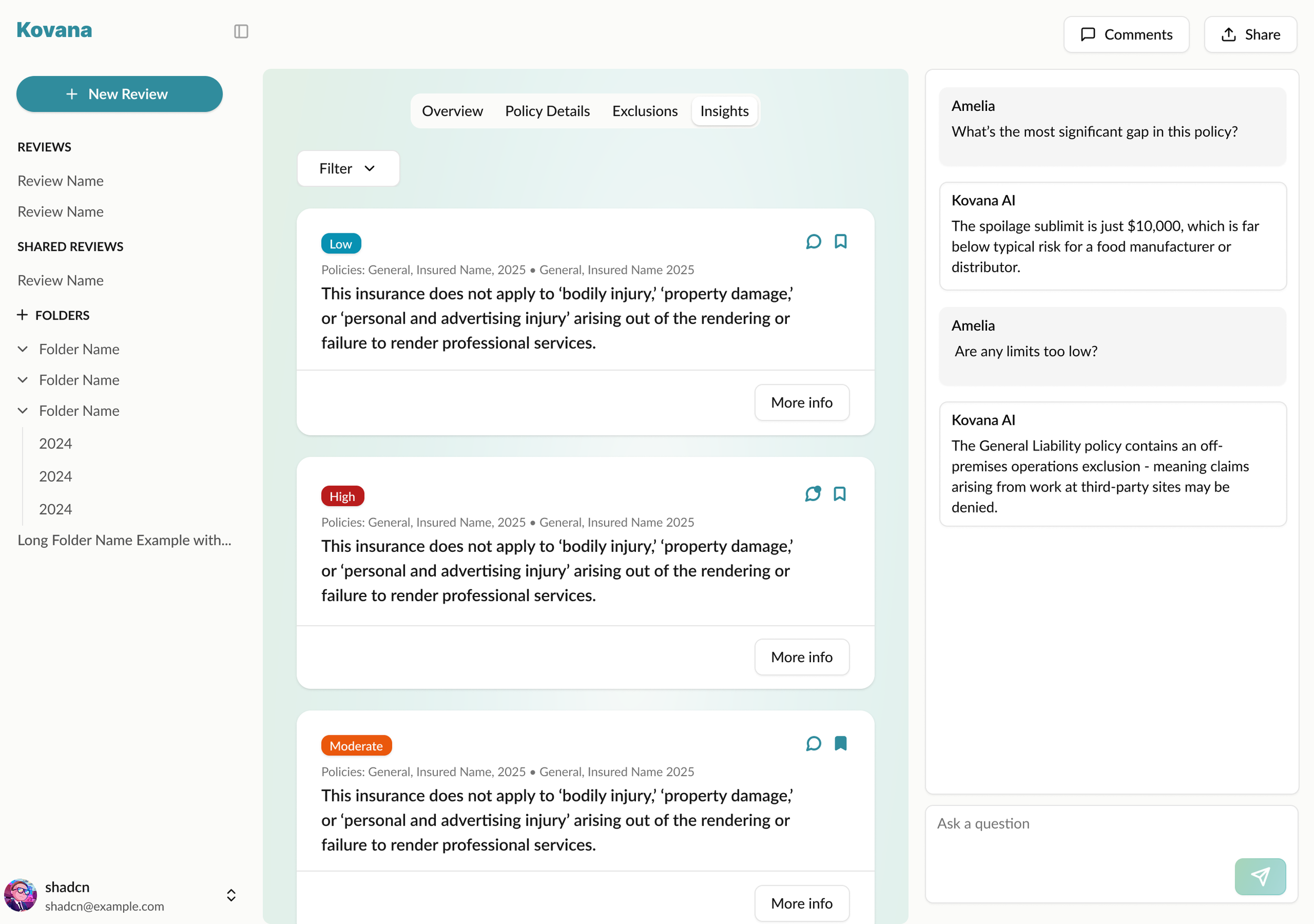
AI-UX translation: Designing intuitive interfaces for first-of-its-kind AI workflows (e.g., contextual chat, document ingestion, exclusion tagging).
Tight timeline: First MVP flow had to be designed in under 3 weeks.
Changing backend constraints: Outputs evolved during dev, requiring rapid UX adjustments mid-sprint.
UX Goals & Success Criteria
-
Create intuitive, role-specific workflows that integrate AI outputs into real-world insurance tasks
-
Design a scalable system that supports both single-policy and multi-policy analysis
-
Ensure outputs are credible, actionable, and client-ready
-
Reflect domain expertise through UI language and layout
Process
Research & Discovery
Analyzed 25 interviews with insurance professionals to identify key personas, uncover pain points around policy complexity, review speed, and client communication.
Ideation & Strategy
Facilitated an information architecture workshop to align product terminology with industry language, then created Interaction Design flows that mapped to UX wireframes tailored to each user role.
Final Design & Prototype
Results and Learnings
-
Shipped MVP in two phases: Single-policy analysis → Multi-policy comparison
-
Pilot engagement from real insurance firms validating time savings and insight clarity
-
Improved confidence in client interactions and pitch decks based on surfaced gaps
-
Built foundational UX systems that scaled with AI capabilities and future policy types