Harvest AI · AI + Real Estate
Turning a fragmented prospecting workflow into an AI-assisted product.
Geographic farming is one of the primary ways real estate agents build a pipeline within a specific market, but identifying the right areas, sourcing property and owner data, organizing leads, and maintaining consistent outreach can require a significant amount of manual work.
I founded Harvest AI to explore how AI and automation could simplify that workflow, beginning with customer discovery and taking the concept through product strategy, workflow design, prototyping, and validation with real estate agents.
- Role
- Founder · Product Strategist · Product Designer
- Scope
- Customer Discovery · Product Strategy · Workflow Mapping · Conversational UX · Prototyping · Validation
Understanding the domain
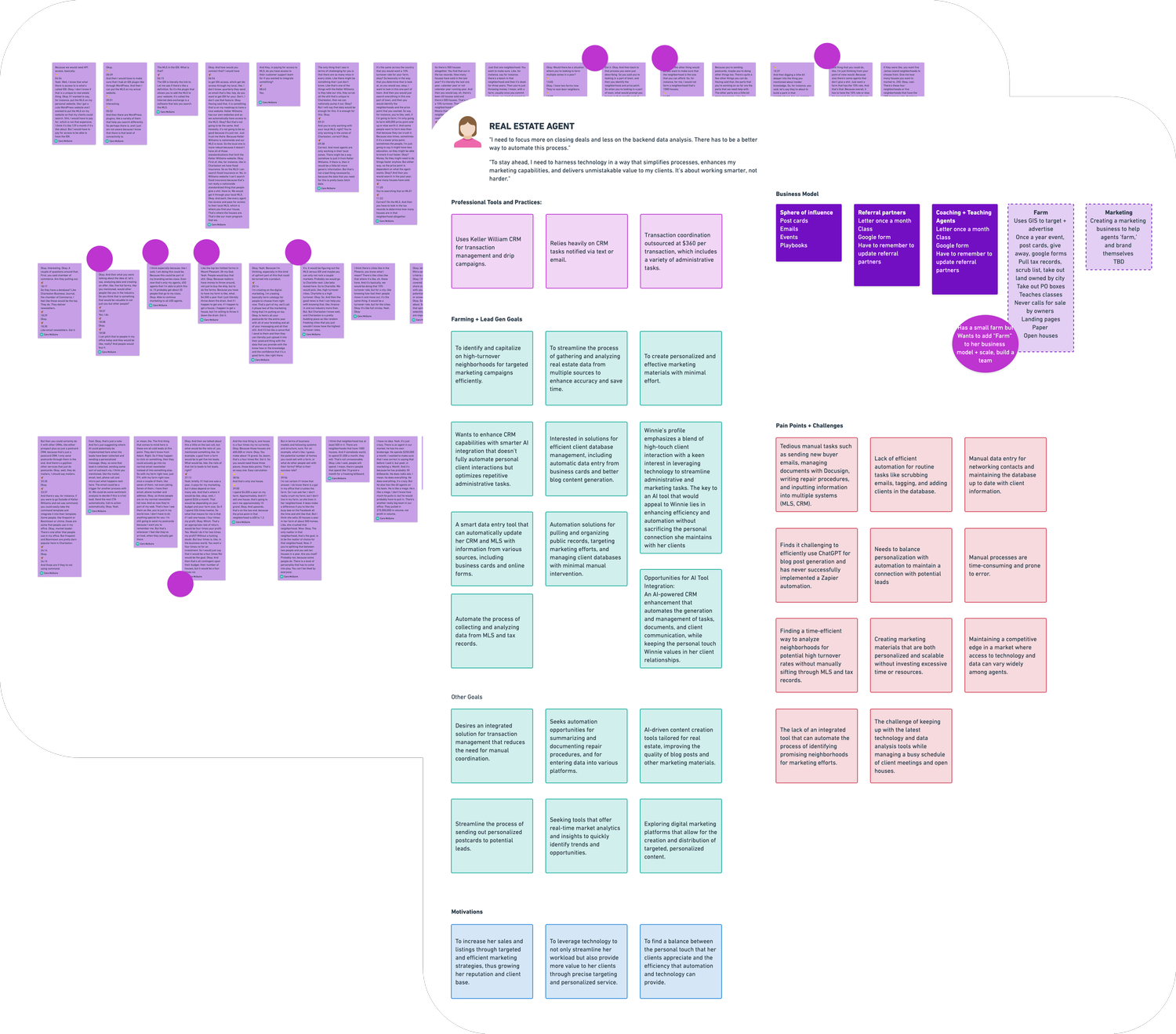
First, I had to understand how agents actually farm a market.
Geographic farming, defined
A real-estate marketing strategy in which an agent consistently focuses prospecting and marketing efforts on a specific geographic area or audience, with the goal of becoming the recognized expert and generating future listings.
The opportunity wasn’t simply to “add AI” to real estate. I needed to understand the existing workflow well enough to identify where automation could remove meaningful friction.
Discovery
Finding the highest-value problem to solve.
The development of Harvest began with customer discovery with real estate agents.
I used those conversations to understand how agents selected geographic farms, sourced potential seller data, organized prospects, conducted outreach, and maintained relationships over time.
The research surfaced several recurring needs:
- 01
Identify promising markets faster
Agents needed a better way to identify geographic areas with meaningful turnover potential.
- 02
Reduce manual data work
Finding, formatting, and managing property and owner information added significant operational work before outreach could even begin.
- 03
Prioritize the right leads
Not every homeowner has the same likelihood of selling, making prioritization an important part of the workflow.
- 04
Stay consistent over time
Geographic farming depends on repeated nurturing, but maintaining that consistency manually is difficult.
Current state
The problem wasn’t one task. It was the entire chain of work.
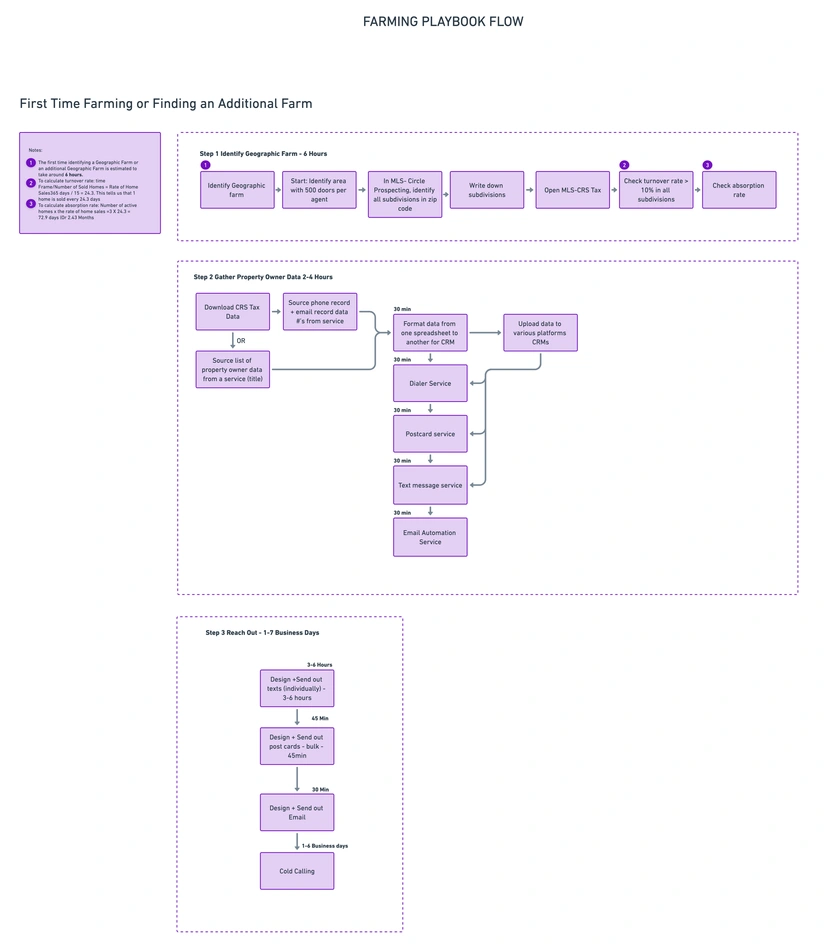
Mapping the agents’ existing geo-farming process revealed that lead generation wasn’t a single action. Agents moved through a sequence of decisions and operational tasks, from selecting a market to sourcing data, evaluating prospects, organizing leads, and maintaining outreach.
I mapped the current-state workflow to identify where agents were spending time, where information changed hands, and where automation could create the most leverage.
Product strategy
Automate the operational work, not the relationship.
The goal wasn’t to replace the agent’s relationship with prospective clients. It was to reduce the repetitive work required to identify, organize, and consistently engage the right opportunities.
The product direction focused on three areas:
Find
Help agents identify promising geographic farms and potential sellers.
Prioritize
Use available property, ownership, contactability, and demographic signals to help agents focus their attention.
Nurture
Support more consistent, personalized outreach without requiring agents to manually manage every interaction.
Future state
Designing a simpler path from market selection to outreach.
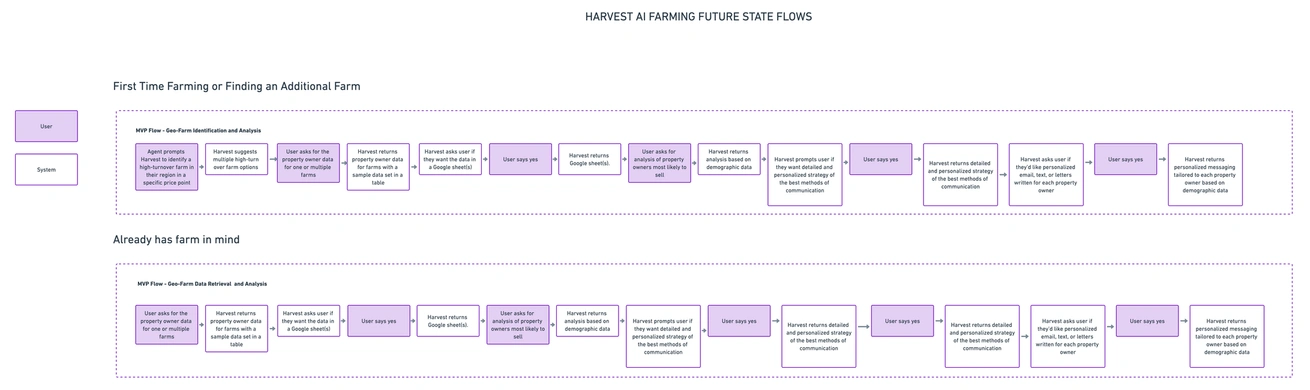
After mapping the current workflow, I explored future-state flows that consolidated fragmented tasks into a more cohesive product experience.
The goal was to move agents from manually assembling their prospecting system toward a workflow where Harvest could help surface opportunities, organize relevant information, and support ongoing lead nurturing.
From strategy to product
Making a complex data workflow feel conversational.
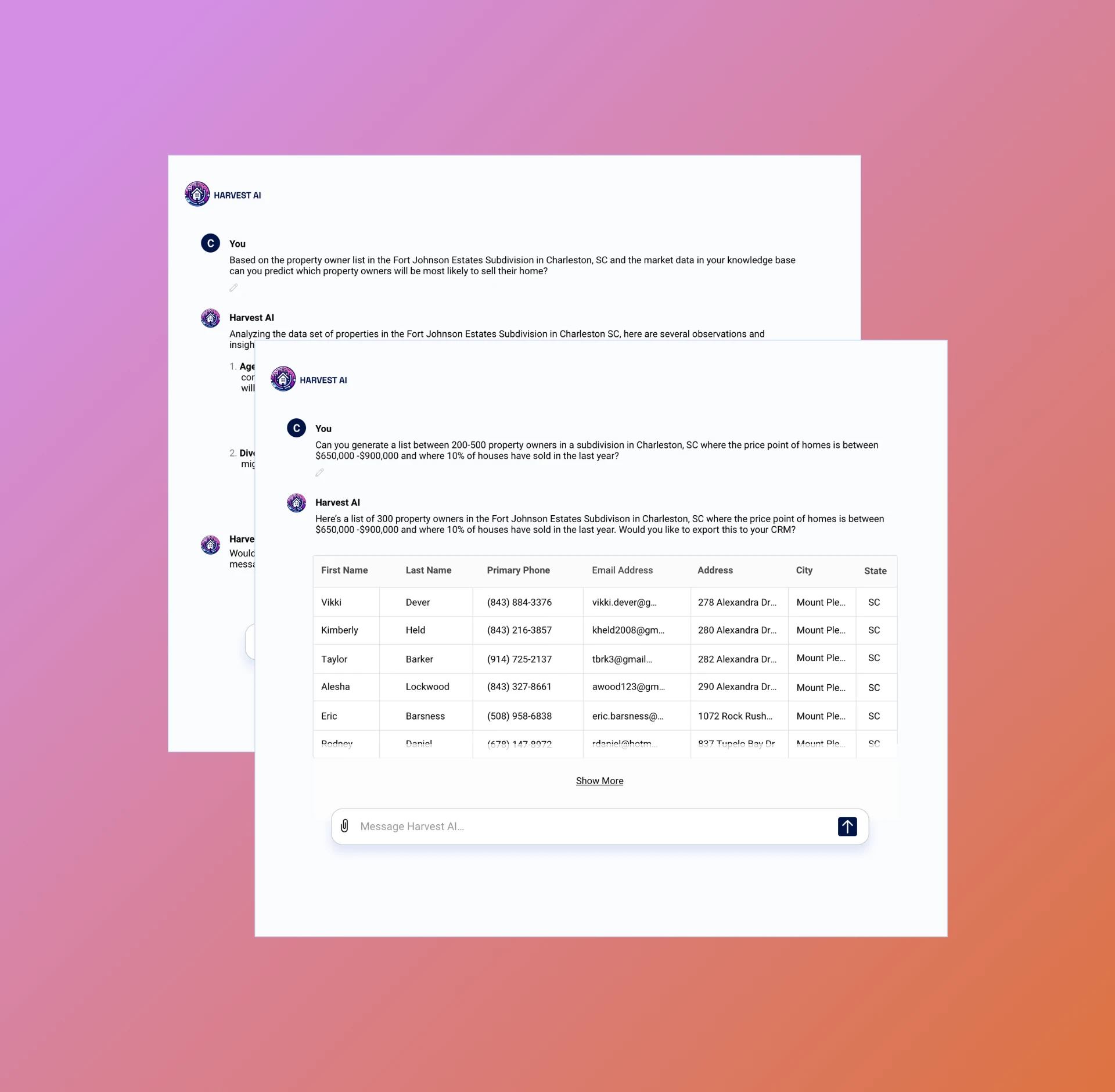
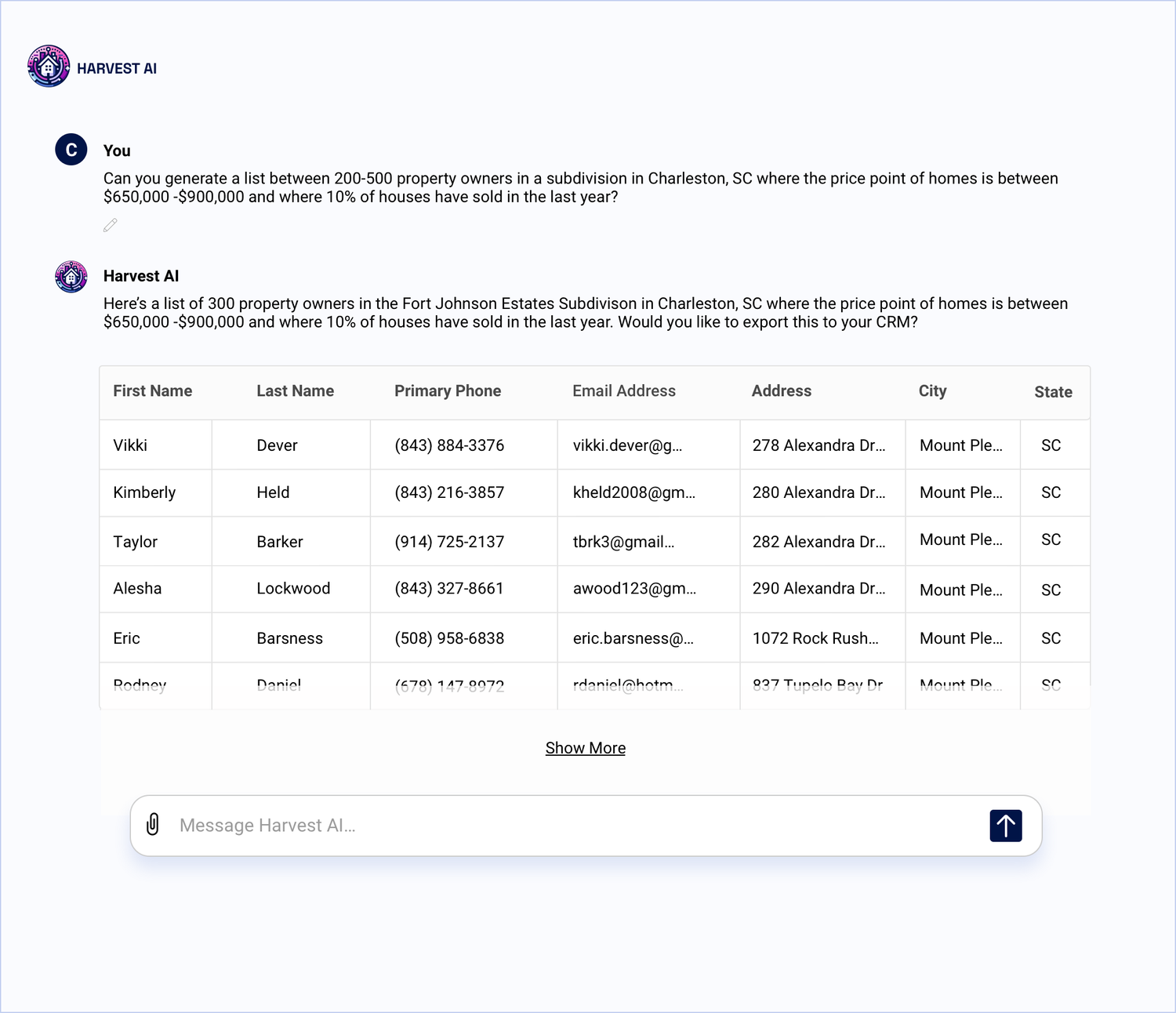
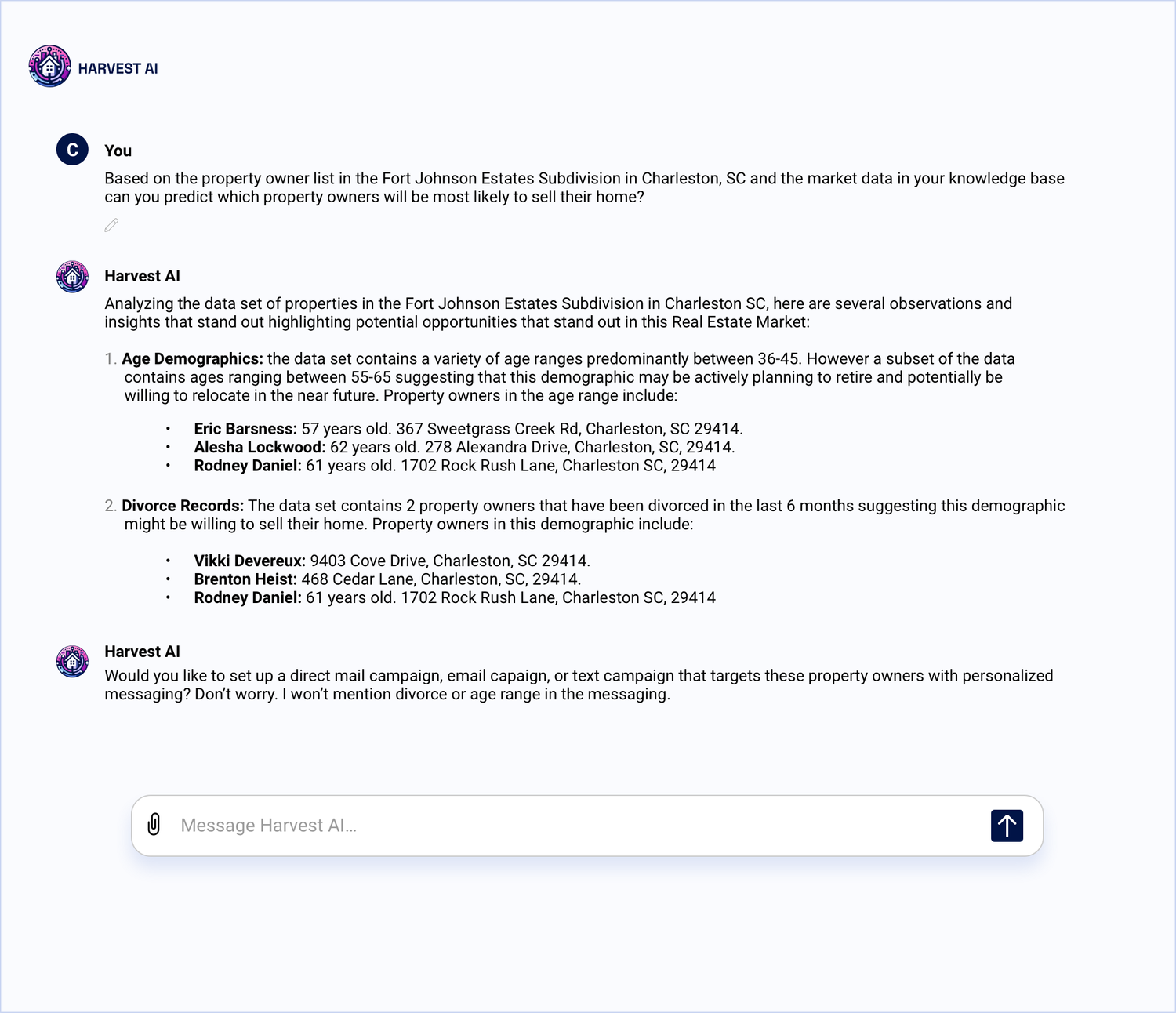
Harvest evolved into a conversational product concept that allowed agents to use natural language to move through parts of the geo-farming workflow.
Instead of requiring users to navigate multiple data tools and manually assemble information, the interaction model explored how agents could express what they were looking for and have Harvest help translate that intent into a more actionable prospecting workflow.
- Ask
- Surface prospects
- Analyze
- Prioritize
Validation
Testing the concept with the people it was designed for.
I created a proof of concept and product demo, then brought the concept back to real estate agents to evaluate whether the proposed experience addressed the problems uncovered during discovery.
Their feedback informed continued iteration on the workflow, interaction model, and prioritization of capabilities.
The goal wasn’t to validate whether agents wanted “AI.” It was to validate whether the proposed workflow made geographic farming meaningfully easier.
Outcome
From customer problem to validated product concept.
Observed problem
Customer discovery
Current-state mapping
Product strategy
Future-state design
Proof of concept
Harvest progressed from an observed workflow problem through customer discovery, current-state mapping, product strategy, future-state design, and an interactive proof of concept.
The project demonstrated how AI could potentially reduce the operational burden of geographic farming while preserving the agent’s role in building relationships and converting opportunities.
Key learning
The best opportunity for AI wasn’t replacing the agent. It was removing the work surrounding the relationship.
Harvest reinforced the importance of understanding an existing workflow before deciding where AI belongs within it.
By starting with customer discovery rather than technology, I could distinguish between the work agents valued doing themselves and the repetitive operational tasks that were better candidates for automation.